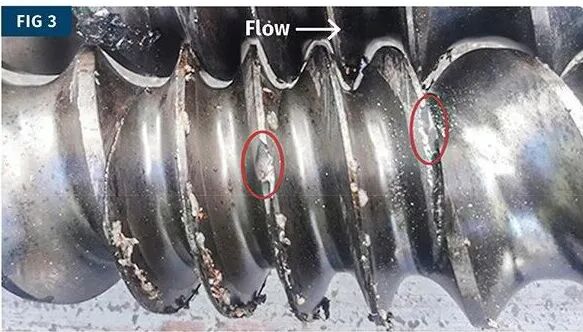
We often hear the saying: “Screw and barrel? They’re consumables. Wear is normal.”
There is nothing wrong with this statement itself. The problem is that when “normal wear and tear” becomes a blind spot in management, it turns into a time bomb for unplanned downtime.
In the plastics compounding industry, delivery pressure is the norm. To meet urgent orders, postponing preventive maintenance (PM) may seem like a cost-effective choice. However, screw and barrel wear is irreversible. Once “minor wear” develops into “excessive clearance,” the consequences are no longer limited to maintenance costs:
- Reduced output: Extrusion throughput decreases, meaning less output for the same energy consumption;
Quality fluctuations: Uneven plasticization can increase the scrap rate; - Increasing energy consumption: To maintain production capacity, operators may have to increase pressure or screw speed, increasing electricity costs while accelerating component wear.
This creates a vicious cycle. Therefore, truly professional equipment management is not about waiting until something breaks before repairing it, but about actively managing its “life cycle.”
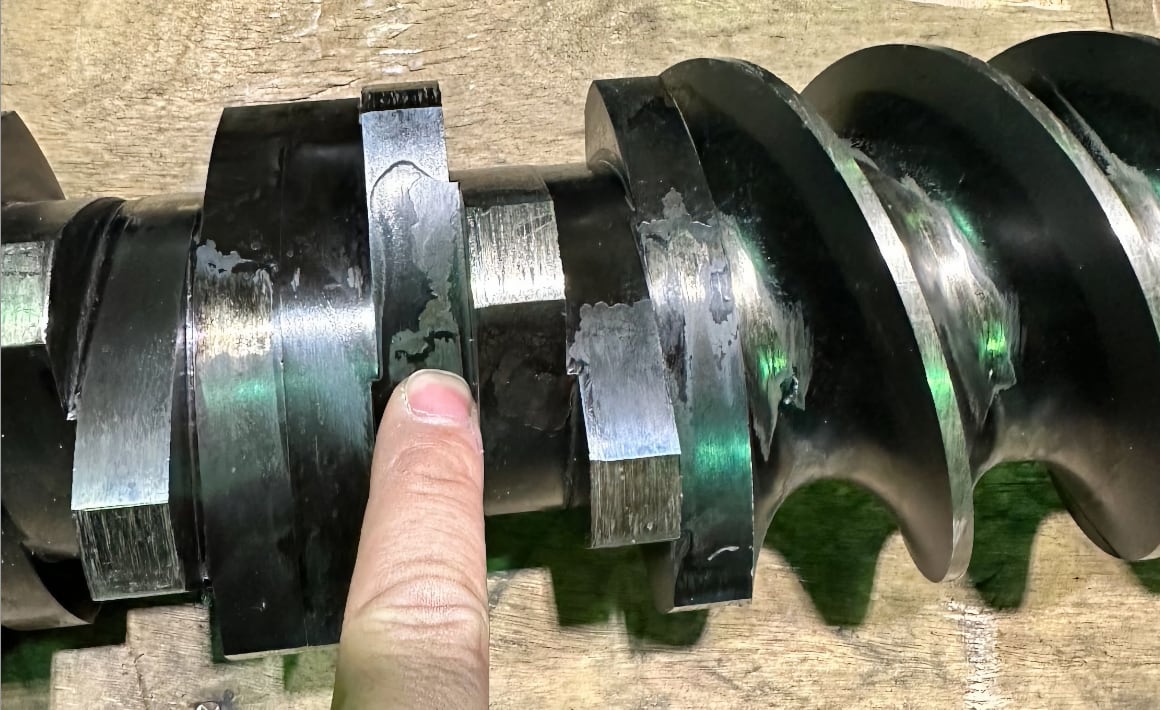
Spalling of the nitrided layer
How can this be implemented? The following can be used as a baseline:
- For abrasive/corrosive materials (such as glass-fiber-reinforced materials and halogen-containing materials): It is recommended to conduct a wear measurement every 6 months.
- For unfilled materials (neat resin): It is recommended to conduct a wear measurement once a year.
After following this schedule for one or two cycles, you can determine the “wear curve” of your screw under a specific process. Once you know when deterioration begins to accelerate, you can arrange replacement or repair before the screw completely fails. Turning “unexpected downtime” into “planned downtime” is the first line of defense.
When discussing maintenance, cleaning cannot be overlooked. To save money, many plants directly use expensive raw materials or recycled materials to “flush” the screw.
On paper, this appears to save the cost of cleaning compounds. In reality, however, there are three hidden costs that are often overlooked:
- Low cleaning efficiency: Repeatedly running material through the machine extends cleaning time. The lost production capacity can cost far more than the cleaning compound.
- Incomplete cleaning: Raw materials do not have specialized stripping capabilities, so residual carbon deposits and black specks may remain. These can eventually become scrap in the next production order.
- Increased wear: Forcing material through the machine at high pressure and high speed can cause greater mechanical damage to the screw and check valve.
The professional approach is to introduce a technically qualified commercial purging compound (CPC) as a standard PM tool.
CPC is not simply a “cleaning material.” Technically, it can address several practical problems:
- Removing “invisible residues”: High-quality CPCs have a certain degree of “negative-flow-region expansion capability,” allowing them to clean degraded material accumulated deep inside screw channels and in dead zones—areas that raw-material flushing cannot effectively reach.
- Reducing the labor required to remove the screw: Before removing the screw, running a dedicated CPC through the machine can soften the material covering the screw surface. Engineers who have experienced difficult screw removal know that the labor required for disassembly can sometimes be greater than that required for screw repair. CPC is specifically intended to reduce this unnecessary downtime.
- “Anti-oxidation protection” during shutdown: For production lines that frequently start and stop, using a thermally stable CPC as a shutdown sealing material can effectively isolate air and prevent oxidation and corrosion of the screw and barrel at high temperatures (which is also an important source of black specks).
- Lower total cost per cleaning cycle: Although CPC may have a higher unit price than raw materials, its higher efficiency and lower required consumption can often reduce the total cost of each cleaning cycle.
For the plastics compounding industry, competition has entered an era of thin margins. The level of equipment management directly determines the bottom line of cost control.
Screws will inevitably wear out—that is a physical law. But smart managers will not wait until the day of forced downtime before paying attention to it.
Establishing a rigorous preventive maintenance system, combined with an appropriate commercial purging compound, puts the service life of the screw and barrel under your control—a calculation worth making.
Disclaimer: (Part of) the data, charts, or other content in this article comes from the Internet or other publicly published materials, and is for readers’ reference, communication, and learning only, and does not involve any commercial behavior or purpose. The copyright belongs to the original author and source. If the copyright owner believes that this article is suspected of infringement or other problems, don’t hesitate to get in touch with us and deal with it in time.